

[INTERVIEW] Development of Precursors for Ruthenium Wiring – Interview with Ryosuke Harada, Chief Manager, Global Marketing/R&D Supervisory Department, TANAKA PRECIOUS METAL TECHNOLOGIES –
May 7, 2026, Electronic Device Industry News
World’s Highest Vapor Pressures
Ruthenium (Ru) and other alternative materials are being developed as part of new wiring technologies for advanced semiconductors. TANAKA PRECIOUS METAL TECHNOLOGIES Co., Ltd. (Chuo-ku, Tokyo) is working on the development of ruthenium precursors for chemical vapor deposition (CVD) and atomic layer deposition (ALD) of ruthenium wiring. In 2020, the company developed a liquid ruthenium precursor that achieved the world’s highest vapor pressures, and it is now gearing up for mass production ahead of widespread use. We spoke with Ryosuke Harada, Chief Manager of the Global Marketing/R&D Supervisory Department, about the properties and future outlook of ruthenium precursors.
―Why are you focusing on CVD/ALD materials?
Harada: CVD and ALD are both technologies for thin film formation on substrates. However, with the miniaturization of semiconductors over recent years, ALD is attracting attention for its ability to achieve uniform film deposition in small, deep holes as well. With ALD, compounds called precursors are vaporized through decompression and heating. When heated substrates are exposed to the vapor, a thin atomic-level film is formed.
Our product range for semiconductors currently includes bonding wires, silver adhesive paste, sputtering targets, plating solutions, and probe pin materials, but we are also focusing on CVD/ALD materials with a view to expanding our range of business activities. We have been developing precursors for ALD for over 20 years and in 2020, we announced a precursor for CVD/ALD processes that achieved the world’s highest vapor pressures.
―What are the properties of the precursors that you developed?
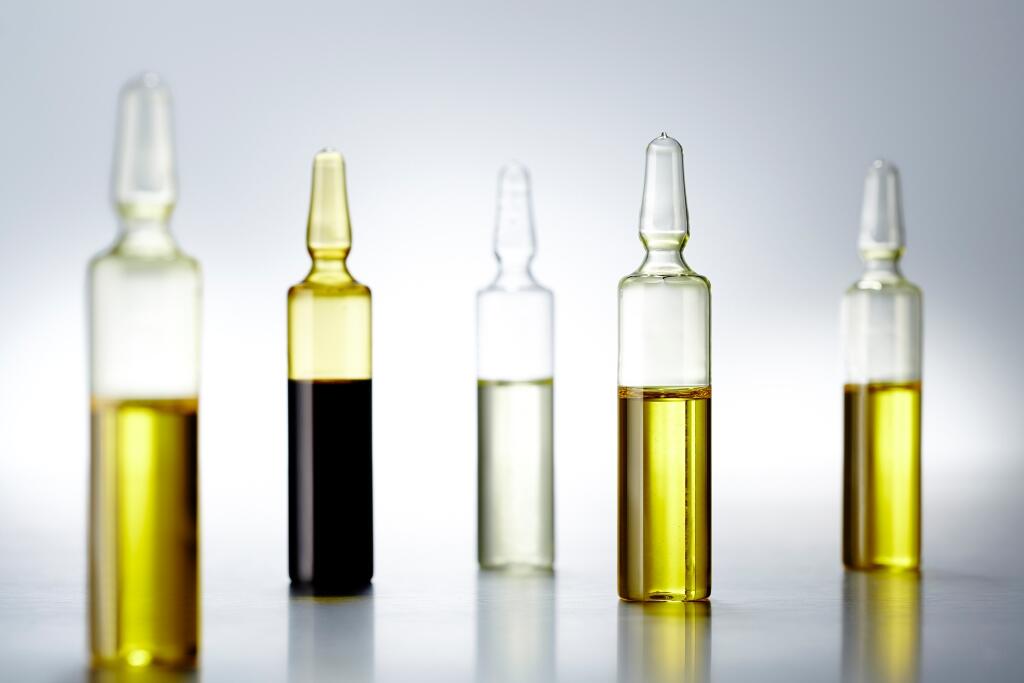
Harada: The main material used for semiconductor wiring at present is copper (Cu). However, we anticipate an increasing change to ruthenium in the future due to its lower electrical resistance and higher durability when compared to copper. We have developed several ruthenium precursors to date, including DCR, RuPta, and TRuST, with DCR being a solid, and RuPta and TRuST being liquids.
Of these three, TRuST achieves the highest vapor pressures (meaning it readily vaporizes) and easily dissolves in reaction gases such as hydrogen and oxygen, which enables the formation of low-resistance ruthenium films. Achieving more than 100 times higher vapor pressure than previous ruthenium precursors at room temperature, TRuST is the world’s leader among liquid precursors.
The higher the vapor pressure and smaller the molecular structure of precursors, the greater their concentration and adsorption to the substrate in the reactor. Compared to previous precursors, TRuST achieves both superior step coverage and film formation speed. Incidentally, film formation at approximately 1.7 angstrom per cycle is possible, making it the world’s fastest of its type using liquid ruthenium precursor.
―How are films formed?
Harada: Films can be formed in either oxygen or hydrogen reaction gases. A two-stage process using oxygen and hydrogen in particular can prevent substrate oxidation and achieve high-quality, low-resistance films. In the first stage, hydrogen is introduced after precursor film formation to reduce oxidation on the substrate surface. After repeating this cycle, the gas is switched to oxygen for film formation. Because the raw material and film formation temperature are the same in each process, total process and equipment costs can be reduced.
―Are there any challenges associated with this technology?
Harada: ALD is able to form ultra-thin films on the surface of fine, complex structures, but very little of the precursor is deposited as a film, so material utilization efficiency is not great. Ruthenium is also a rare material, and its price has been increasing in recent years. From the perspectives of resource conservation and supply stability as well, it is necessary to recover and recycle unused precursor. We have also been developing technologies to recover unused precursor after film deposition to return high-purity ruthenium.
―What is the future outlook?
Harada: At the moment, we anticipate that this technology will be used for ruthenium wiring on advanced semiconductors of 2 nanometers and beyond. We are therefore gearing up for mass production ahead of widespread use. We are also developing other precious metal precursors for CVD and ALD processes, apart from ruthenium, in the hope that CVD/ALD materials will become a future growth business for us.
(Interviewer: Shingo Matsunaga, Editorial Department, Electronic Device Industry News)
This article, reprinted with the permission of Sangyo Times, Inc., was published in the May 7, 2026, issue of Electronic Device Industry News.
It has been translated into English by TANAKA PRECIOUS METAL TECHNOLOGIES with the permission of Sangyo Times, Inc.
Related Information

Semiconductor Fabrication and TANAKA
Since its establishment in 1885,TANAKA has advanced hand-in-hand with Japan’s manufacturing industry as a specialist in precious metals.
How was this article?
If you found this helpful, please share it.


